Showing posts with label Great Spotted Woodpecker. Show all posts

Sunday, 21 June 2015

May 2015

Nature Notes: May 2015


I couldn't wash my face in the morning dew on the first of May as there was a rather hard frost. Although I felt this was rather unseasonal it was not the last of the month.
There was quite a lot of firsts this month:
The first sound of the cuckoo (Cuculus canorus), the first drumming of the great spotted woodpecker (Dendrocopos major) and the first swallow (Hirundo rustica), all of which were on the 9th.
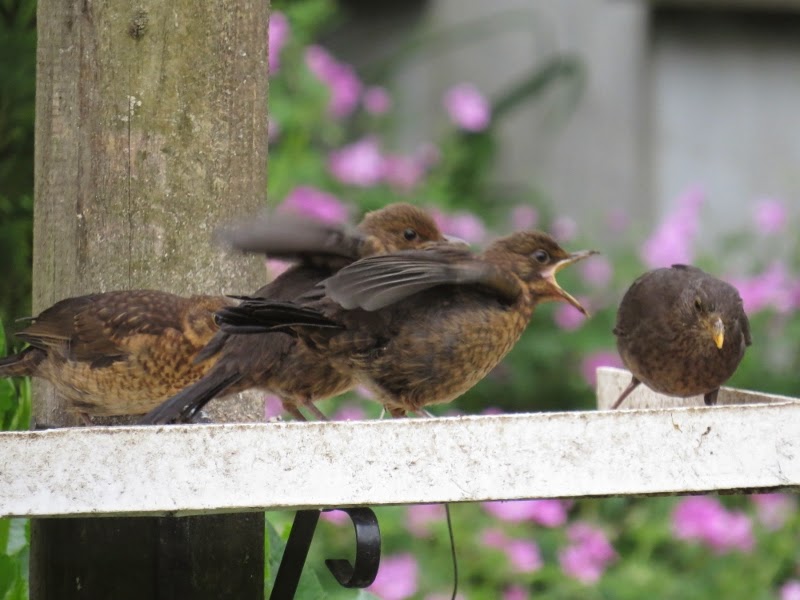
The breeding season brought fourth its results on the 13th in the shape of a young blackbird (Turdus merula); the first juvenile of the year.


We had to wait until the 23rd before the starlings(Sturnus vulgaris) introduced us to their new broods.


 Two families of turned up with three young each. The parents were pecking off mouthfuls of suet block (the birds are eating one a day now, with a little help from a squirrel) and feeding them to their squabbling young.


With all this activity around the feeders it is becoming more common to see a sparrowhawk swooping in to come to grips with some fledgling prey. When the alarm call goes up the birds scatter to the safety of the bushes. However, the sparrowhawk (Accipiter nisus) can be seen plunging into the bush to grab a bird from the supposed safe cover of it's conifer shelter.

The birds are not the only creatures who have been procreating this spring as we have some unwelcome visitors in the shape of three rats (Rattus norvegicus) . Three rats in the daylight probably means many more under the cover of night. That's life.

This sparrow kept looking through the window


A female eider duck with ducklings on the Firth  of  Forth

Sunday, 11 January 2015

Nature Notes: December 2014


Birds

A normal December day started with the blackbirds (Turdus merula) arriving in the half light of morning. The alarm call of the blackbird always heralds the first light as they stake their individual claims to the feeders. They expend a lot of energy sorting out the pecking order and local disputes. There is one female who seems to be the boss or perhaps she is just the most aggressive. I suppose females compete for resources and males compete for mates.


By 08:00 the wren (Troglodytes troglodytes), robin (Erithacus rubecula) and tits are beginning to arrive. The next on the feeders are the gang of sparrows, who together with the tits pick their favourite seed and then scatter any they reject.

Under the table is the spent dried mass of fallen leaves and decayed flower stalks; it is here that we find the hedge sparrow or dunnock (Prunella modularis) picking up the fallen seed. 


He is not alone in this occupation as up to ten chaffinches (Fringilla coelebscan be found flitting between the seed of the table and the ground.
The time is now 08:30 and the first woodpecker (Dendrocopos major) arrives. Suet is usually their favourite food and their first port of call. However, they are rather fond of peanuts as well. The one thing that makes peanuts more attractive is the fact that a second woodpecker has arrived and is tucking into them. This usually always ends with a chase.

On a cold frosty morning when the birdbath is frozen solid and the daylight lasts for a little more than six hours the birds race to get as many calories inside themselves before night falls again. They jostle for position, they flap their wings, they peck each other, they fight territorial squabbles and then they are startled from their occupation to flee to the safety of a nearby bush.
Then little by little the bravest return and the feeding starts again.

Other bird sights for December were:
A mixed flock of thrushes, redwings and fieldfares eating the holly berries and fallen crab apples on the Roman Road.


Ten blackbirds eating the remains of the fallen apples in the garden.

One starling (Sturnus vulgaris) came to feed at the table but didn't stay long. I wonder if he had been part of the murmuration I saw last month?

Two buzzards (Buteo buteo) still flying about B woods area.

Ten collared doves (Streptopelia decaocto) were seen in the garden on the 20th. This is really exceptional as we usually only have two or three at the most.

Three long tailed tits (Aegithalos caudatus) in Junk Woods

A cock pheasant comes into the garden every day to search for seed under the bird table.

Mammals

Two groups of roe deer (Capreolus capreolus) are often seen in the fields near the house. There is what looks like a larger individual and a smaller companion. There is also another group of three.

One evening after Christmas I was walking on Yellowcraig beach at dusk when I spotted a dead porpoise on the beach. The head and tail were intact but the blubber had been removed from the rest of the body. This gave it the appearance of an anatomical model. Close by was a flock of crows silhouetted by the moonlight as they waited by the tide line.
The next morning I walked the same stretch of beach and all that was left of the porpoise was the backbone and the upper jaw. I suppose such a good meal doesn’t turn up everyday.


Sunday, 13 July 2014

June Nature Notes

June 2014

I think I will start using Latin names for the species which will be an aid to help me learn them and as a way to avoid confusion between species.
So far we have not seen many corvids in the garden although there are plenty in the area around us. However they have started to venture more often into the garden now. By 08:40 on the 6th I had seen three jackdaws (Corvus monedula), a rook (Corvus frugilegus)and a jay (Garrulus glandarius). They are very cautious and don't stay long.
This was another month for the sighting of many juvenile birds visiting the feeders usually in the company of at least one parent. Here is a list of some of the sightings;
8th Coal tit (Periparus ater) and great tit (Parus major)
20th Three blackbirds (Turdus merula) on the bird table being fed by the mother. The young could be mistaken for thrushes because they have similar breast patterns.


21st Tree sparrow (Passer montanus) feeding the young with seeds. These were part of a flock of mixed sparrows numbering at least 30. A young starling was seen on the same day being fed with mealworms.
23rd A baby robin (Erithacus rubecula) on the bird table.
We were also treated to the arrival of our first juvenile great spotted woodpeckers (Dendrocopos major). The first sighting was on the 5th. I could see the male parent taking suet to feed a bird on a distant branch. Eventually the juvenile came closer but still kept his distance from the feeders and waited for the parent to bring the food to him. On the 10th a juvenile was feeding alone on the fat balls.


 On the 15th the two juveniles were on the feeders together with a female GSW. One was feeding independently. However by the 18th the two juveniles were fighting each other over access to the fat balls.
One of the juveniles had a narrow escape when a sparrowhawk (Accipiter nisus) swooped past the feeders. Another bird did not have such luck and was seen spread spreadeagled on the ground, pinned down by the sparrowhawk, whilst it pecked at. I couldn't see what type of bird it was but it seemed to have wide narrow wings like a swift or swallow. After about five minutes it flew off to the chessnut tree with the dead bird. A few minutes later I saw it fly towards the farm with a very limp looking body gripped in one tallon.


The goldfinch (Carduelis carduelis) has been absent from the feeders in the numbers that were present in the past but I did shot this one out the living room window.


Mammals

There is a hare (Lepus europaeus) that comes up the farm road to just outside the garden and then walks back down again, he sometimes ventures into the garden if the gate is open. I don't think there has been a time when I have walked down the farm road and not seen at least one hare. On the evening of the 24th I saw seven.
The mouse is out and about under the feeders from time to time.


There is usually no more than one at a time.
Two or three rabbits (Oryctolagus cuniculus) are making themselves at home in the garden.


Three squirrels  (Sciurus carolinensis) come to the garden. During the winter the squirrel never bothered the feeders but now likes to take his fill. Perhaps the food he had stored last autumn has ran out and a new source has not come to fruition.


I saw a fox on the farm road. It was late in the evening in the area where many rabbits gather. This was the first sighting of a fox since we came here.
Insects
The damp brings out the slugs and I spotted a fine example of a leopard slug (Limax maximus).

Time to end with a nice pair of tits.


Sunday, 11 May 2014

April 2014 Nature Notes

The need for water for the birds to drink and bathe in became more important as the days grew warmer.

Great spotted woodpecker having a drink to wash down all the suet 
Early in the month the GSWs were arriving thick and fast at the bird feeders, sometimes up to four at a time then a lot of chasing and calling would ensue.
There was a lot of birds visiting the garden at the beginning of the month, some of which rarely if ever came into the garden in the winter time such as magpies, crows and even a jay. The jay was chased off from the birch tree by a blackbird.
The blackbirds are the most industrious of birds. They really burn the candle at both ends. Evidence of their productivity was evident when the first of their offspring could be seen begging for food from the male. It was always the male that fed the young.

Feeding time....

....and a drink to follow.
On Sunday 13th at 18:00 a flock of about 12 goldfinches came to feed. They show the usual pecking order of the top two sitting on the niger seed feeder and the others squabbling about the places on the other seed feeder. 
I spotted two bullfinches on the Roman Road. I also noticed a rather large greenfinch which looked old or ill. I though the birds may be getting some sort of disease but he still visits weeks later and still looks the same.

He may look ill  but he has no loss of appetite

There has definitely been a reduction in the number of tits visiting although two long tailed tits have been spotted flitting from feeder to feeder. One of them rather bravely pecked at the GSW which was feeding on the suet block.


On Tuesday 15th I saw the first (rather distant) swallow of the year.
Two yellowhammer females often visit the garden at the same time. However, I have not seen the male as much as of old. I suppose birds are busier at this time of year with mating and rearing young than the single mindedness of feeding that occupies them in the winter.
On Sunday 13th at 09:45 I spotted four buzzards flying over Junk woods.

 I watched gannets diving in the Firth of Forth.


I also caught this thrush singing on a branch near the buckthorn.


By the 25th the U lake had many ducklings, goslings, baby coots and probably some young great crested grebes.

Mammals

The mice were still out and about picking up seed etc at the bird table. Unfortunately so was the larger more unwelcome rodent the rat. I suppose seed always attracts rats.


The last I saw of the cat was a few weeks ago when he was settling down for a sleep in the afternoon sun.

Come back pussy you have some work to do!

Plants

April was a good month for blossom and bluebells.

Cherry in blossom at the U
Blackthorn in blossom near B woods

Bluebells in B wood


How about a nice millipede to end the month on. 

 Polydesmus coriaceus (?)