Showing posts with label Goosander. Show all posts

Sunday, 14 December 2014

Nature Notes: November 2014


Birds

With the shorter days came less time for viewing nature. 
November was rather grey, wet and mild. 
However the cooler shorter days are bringing the birds back to the garden. All the usual species are back in at least low numbers, except the greenfinch (Carduelis chloris), which has only been spotted once this month. I also don't see them on my local walks either.
I did see a bullfinch (Pyrrhula pyrrhula) at Junk Woods on the morning of the first.
A mixed flock of sparrows often dominate the bird table. They seem to be about 60% house (Passer domesticus) and 40% tree (Passer montanus). There is also the odd hedge sparrow or dunnock (Prunella modularis) which is a more solitary individual.

I spotted at least five goosanders (Mergus merganser) on the River Wharfe at Tadcaster, 

Goosander 

Three buzzards (Buteo buteo) at B woods, and a murmuration of starlings (Sturnus vulgaris)at the flyover. I spent some time filming the murmuration on the afternoon of the 29th. They started about 15:50 and it was all over by 16:30. They dropped out of the sky to roost in the shrubs around the pond. There must have been about 500 of them. Quite a spectacular spectacle.
Whilst this was going on there was a kestrel hunting in the field nearby.

Cock pheasant through the kitchen window

Mammals

A tortoiseshell cat was seen in the garden on the 1st but after a couple of other visits has now disappeared again.
Although we used to have rabbits in the garden every day in the summer they are now a very rare occurrence, only one has been spotted in the last couple of months.

Plants

I took some photographs of plants that were still in flower on the last day of the month. I suppose this is testament to the mild weather.

Buttercup in perspective

Nasturtium

Geranium


Fungi

The wet weather has also been good for the fungi.

Part of the fairy ring?

The common name of Auricularia auricula-judae - 'Jew's Ear'-may have come from 'Judas' Ear'. This refers to a common belief that Judas hanged himself from an elder tree, the common host of this fungus.

Winter sunlight captured through a fallen sycamore leaf


Saturday, 12 April 2014

March Nature Notes

March

The month started with a slight frost which lead to a sunny day. Nothing like a bit of sun to get everything out and about. I noted the first daffodil in the garden to flower, the first bumble bee, fly, and the first time a magpie visited the garden. The magpie is a nervous caller, only briefly stopping on the table to gulp down some nibble before darting off again. I also watched him try to take flying bites from the hanging suet block.
A pair of starlings are now regular addition to the many garden feeders. They are also showing some interest in a bird box above the garage which is also getting attention from the house sparrows.
The small birds such as the tits and finches are usually the most numerous. The goldfinches topped the chart on the one hour bird count at the beginning of the month. The seed feeders in general being the most popular.
A couple of new additions was a pied wagtail and a possible sighting of a siskin on the niger seeds....just a brief glimpse. However the yellowhammer visits much more often now and has on occasion been seen with a female. They are always feeding on the ground so far.

Yellowhammer male

I shot a video of a yellow hammer singing on a branch on an early morning walk near B woods.
I saw two blackbirds mating on the log pile on the 8th and a pair were building a nest in a conifer bush at the front of the house on the 31st. I also found a large dead baby bird on the drive on the same morning, I'm not sure what species it was as it wasn't well developed.
There was an increase in the number of visits by the great spotted woodpeckers (GSW). We now have at least four different birds but there could be more. The more that I watch the more I can see differences between the different birds. These include the more obvious red patch that separates adult males from females but there is also other characteristics such as the number of white bands on the tail and colouring of a 'nose' band and chest. I propose that the more mature birds have a deeper ruffous colouring to these parts.
I heard three GSWs 'drumming' in B woods and shot some film of one that was just in range of my zoom.

Other sightings

A black cap chirping on a branch in Spring Lane.
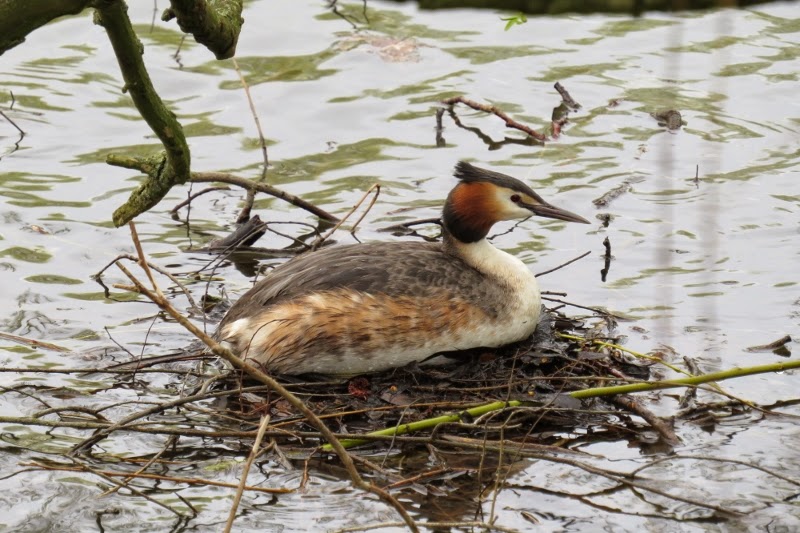
Two pairs of great crested grebes nesting on U lake.


Ten or so goosanders on U lake. A mixture of males and females. They came last year but didn't stay for more than one weekend. 'These birds have been here most of the month now. 


These handsome diving ducks are a member of the sawbill family, so called because of their long, serrated bills, used for catching fish. A largely freshwater bird, the goosander first bred in the UK in 1871. It built up numbers in Scotland and then since 1970 it has spread across northern England into Wales, reaching south-west England.' http://www.rspb.org.uk/wildlife/birdguide/name/g/goosander/

On Sunday the 30th there was a toad trying to get out from an empty plant pot in the glasshouse. I gave him a lift and deposited him under some geraniums where I have seen frogs / toads before.


Mammals

If I took an average of the deer and hares seen on my local walks then the deer would be 3.25 per walk and 1.25 hares.
No mice were spotted until the 7th when a new larger mouse was seen taking seed from the ground. Then the little mouse was back out on the 10th at his usual patch. Then on the 14th he had two companions. Made me wonder just how many were in the area around the feeders? There certainly are a lot of mouse holes in the soil. I thought we were in for a summer of many mice but the long haired Siamese (LHS) discovered there existence and probably put an end to it. I saw him sitting in the dusk looking wonderfully eerie. There was no sighting of a mouse until the 30th. Even if he did eat them all, I suppose with a good niche like the area around the feeders it wouldn't be long before another mouse family would move in.