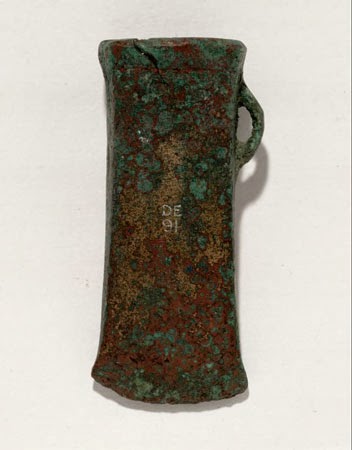
The Early Remains: A time of
myth and legend
Out of the dark places;
out of the howling mists;out of the lands without sun a traveller
came. Strong and upright he strode the earth with the knowledge
imparted to him by the young sun. Perhaps one of the last of the line
of the Gaernedd Uchaf he rested at the foot of Dunpendyrlaw
for seven moons. In this time constellations could be seen to form in
the darkness of his long black beard and runes appeared etched in
starlight on his brow. His eyes searched the horizon of nights
blackest shores for a sign. Then when the seventh moon was at its
fullest a great raven could be seen flying out of the east to meet
him. Held tightly in its claws was a parcel wrapped in finest tweed
woven by the handmaidens of Pwyll
Pen Annwn. This material had come from the bridal gown of Lofn which
was woven with enchanted gold filigree to protect her from the
mischievous Loki.
The raven with a mighty
Cronk! let the parcel fall at the feet of the traveller. Then
spiralling down from the sky wing swept in black he landed. The
traveller recognised this stately bird for it was none other than
Foel-goch lord of the raven hordes of A'Chòigeach. Unwrapping the
parcel he quickly revealed it to be Am Baistei, the most powerful and
the last of the mighty two handed battle axes to have been forged by
the ancient iron masters of Rocascreag. Without any hesitation he
hefted the axe and swung it in a great arc over his head to cleave
the rock of Dunpendyrlaw. Sparks
flew as axe hit rock, then axe and rock became one. Then raven and
traveller where silhouetted on the skyline by a mighty cataclysm as
the iron in the axe called forth it's brethren ore to form as one. In
this great metamorphosis was born Eubh who reached back into the
cataclysm to pull forth Adhamh and thus they were forged from the
moonlight, fire and molten ore. Then the traveller reached into the
maelstrom and beckoned forth a large beast which would provide for
the people. Turning to Eubh and Adhamh he said this beast and its
offspring shall be known as Elancoo care for her and she will
provide. With this the couple and their beast walked into the night
towards the shores of Bearaig a Tuath. As they went on their way a
soft rain came to meet them and as it fell it reacted with their hair
and turned it a rich orangey red colour which was a characteristic of
the ore from which they were formed.
Thus is the story of the
creation of the first people of Scotland; how they got their red
hair; how Traprain Law lost its iron ore and gained a great wound to
it's side which will never heal.
Yes, this is a time of
myth and legend. This could also be portrayed as a time of grunting
cavemen saving Raquel Welch from the clutches of a pterodactyl. A
time of Pictish princes' with a magic bag of Celtic dreams and New
Age nonsense; into which anything can be put and anything taken. This
is the period that followed on from the last ice age. A period which
is most open to interpretation, due to a lack of a written record. So
with no written record we have to rely on archaeology. What we must
not lose sight of is the fact that the prehistoric period in Scotland
stretched for up to 10 000i
years, which is by far the biggest chunk of our history and yet it is
the least known and most dismissed.
I think we would be
wrong to consider history as a progression of man's existence from
prehistoric savagery to modern sophistication; with only a brief
period of enlightenment during the Roman period. No, these were
normal everyday people going about their everyday lives with all the
same hopes, fears, joy, pain and discoveries that people have always
done and still do. A world full of courageous pioneers showing
ingenuity and vision but also a world of soldiers, thieves priests
and idiots; just like it is today.
For
our progression through time we will separate it into the traditional
periods of prehistory namely; Stone Age, Bronze Age, Iron Age and
Dark Ages. As was mentioned previously there is no written record so
we shall try to paint a picture of life in the Luffness area from the
finds and excavations that have occurred there. Sometimes we may need
to look at the wider context of Scotland so that we can infer what
may have been taking place in Luffness.
I
have compiled a table of all the archaeological small finds and
events that are listed on the Royal Commission for Ancient and
Historic Monuments websiteii.
The items relevant to each period will appear in a table in each
chapter.
So
who were the first people of Scotland and where did they come from?
Any
evidence of the first people of Scotland was wiped clear from the
landscape by successive ice ages. So, who were the people who first
populated the new landscape of Scotland as the ice retreated for the
last time and the climate warmed? The short answer is nobody knowsiii.
Evidence for the earliest human presence comes to us in the form of
archaeological finds such as a flint arrowhead found on Islay and
dated to 10 800 BCiv
or another flint discovery in 2009 from Biggar:
'Archaeologists have discovered the
earliest evidence of human beings ever found in Scotland.'.v
These
flints were originally dated to about 3000 BC but are now thought to
be similar to tools known to have been used in the Netherlands and
northern Germany in about 12,000 BC.
However
the earliest available direct Scottish radiocarbon dated evidence for
human activity comes from the east coast of Scotland at Cramond near
Edinburgh. Waste
pits and discarded hazelnut shells found there have been dated to
about 8,500 BCvi.
East Lothian can boast that they have the oldest remains of a
permanent house, which have been dated to about 8000 BC. These were
found during an archaeological excavation in 2003 at East Barns near
Dunbarvii.
I should note at this point that a new contender for the oldest
building has been discovered in 2012 at Echline, South Queensferry
and I quote:
'.....has
been dated to the Mesolithic period, around 10,252 years ago.'viii.
All
this evidence indicates that this coast from Howick in
Northumberlandix
and all along the Firth of Forth was settled very quickly after the
last ice retreated.
This
would mean that people were inhabiting the area before most tree
species had recolonised the post glacial landscape. These people
would probably have lived by hunting, gathering and fishing in a
habitat that would be dominated by grasses, herb species, willow and
birch scrubx.
The
only personal possessions that survive are their stone tools such as
arrowheads and scrapers while their otherwise organic possessions
would have rotted back into the earth. So, what remains have been
found for people being active in the Luffness area during the
Mesolithic and Neolithic periods?
Luffness
8000 BC to 2000 BC
We
have seen in the previous chapter that this is quite a dynamic
coastline, which can either wash away evidence of settlement or bury
it under huge amounts of wind blown sand. However, finds from this
period do occur and their details can be seen in (Table
1). Many flint items such as arrowheads and scrapers have
been found along the coast from Aberlady to Dirleton (illustration
1)xi.
These finds are thought to range in date from about 7500 BC to 2000
BC with characteristic change in quality and material from which they
were made.
| RCAHMS SITE NUMBER |
LOCATION OF FIND |
SITE TYPE |
| NT48SE 20 |
Gullane Golf Course |
ARROWHEAD(S) (FLINT) |
| NT48NE 5 |
Gullane Links |
ARROWHEAD(S) (FLINT) |
| NT48SE 11 |
Gullane Point |
AXEHEAD (GREENSTONE) |
| NT48NE 6 |
Gullane Links |
ARROWHEAD(S) (FLINT), |
| NT48SE 27 |
Gullane Links |
LITHIC IMPLEMENT(S) (FLINT) |
| NT48SE 22 |
Gullane Sands |
MICROLITH(S) |
| NT48NE 8 |
Between Gullane Black Rocks and Eyebroughy |
MIDDEN(S) |
| NT48SE 32 |
Gala Law |
MIDDEN |
Table
1: Stone Age finds from the Luffness area
Illustration
1: Proceedings of the Society of Antiquaries of Scotland;
Donations to and purchases for the museum 1955-56: p458
Flint
provided the material from which tools could be made and remained in
use for thousands of years. Evidence of settlement in the Luffness
area comes from domestic refuse that forms the remains of a midden
(NT48SE 32) on the high ground of Gala Law.
Evidence
of farming has been found in Scotland that dates back to about 3500
BCxii,
when Neolithic man was using fire to clear the forests for grazing
animals. However, this was not a linear progression in agriculture
but a series of expansions and contractions over hundreds of years
dictated by changes in climate, soil exhaustion and erosion.
Finds
such as the polished greenstone axe, 3 3/4" x 2 3/4", found
in a sandbank at Gullane Point (NT48SE 11) in 1880, indicates that at
times a surplus of food was being produced, which allowed the
individual who made the axe time to dedicate to developing their
skill at axe making. Axes were not only the must have tool for
thousands of years but according to the National Museum of Scotland
miniature axeheads were probably symbols of power and prestige with
some religious significance xiii:
The
museum also holds axeheads made of polished flint (illustration
2)
from about 3000 BC, one of which was found at Gilmerton at
Athelstaneford and is described thusxiv:
'Similar axeheads have been found
scattered along the eastern coast of Scotland and England. They were
prestige items, for ceremonial use.'.
Illustration
2: These four flint axeheads were found at Craigentinny,
Edinburgh, two at Smerrick at Enzie in Banffshire, and the fourth at
Gilmerton at Athelstaneford in East Lothian. These axeheads may have
been made from flint found off the east coat of England.
The
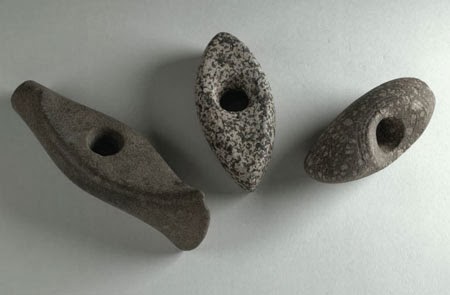
NMS also holds a polished greenstone battle-axe that was found in
Longniddry (illustration
3)
and could be 4200 years old. The battle axe could have been used as a
weapon but it is thought that their principal role was as fashionable
prestige objects, or symbols of powerxv.
Illustration
3: These three stone battle axeheads were found at Longniddry in
East Lothian, at Portpatrick in Wigtownshire and at Chapelton in
Ayrshire. The Portpatrick and Longniddry axeheads are polished, the
latter also decorated with broad grooves along the long surfaces.
The Chapelton axehead is decorated with three narrow grooves. All
were originally mounted on handles.
Symbol
of power or for bashing the brains out of your enemy; discoveries
like this reveal that a society of sophisticated people were active
in the region during the Neolithic period.
If
we follow the trail of finds that are listed in the table we can see
that the desire for axes did not stop at the stone age but continued
on through time into a new age of metallurgy; an age we shall now
explore.
ii
http://www.rcahms.gov.uk/
iii
The
New Penguin History of Scotland: From the Earliest Times to the
Present Day
edited
by: R. A. Houston, W. W. J. Knox
London,
Allen Lane, The Penguin Press in association with the National
Museums of Scotland, 2001, ISBN: 9780713991871
Page 4.
ivMoffat
A., 2005, Before Scotland: The story of Scotland Before History,
ISBN. 0500005133X, Page. 42
vi
http://archaeologydataservice.ac.uk/catalogue/adsdata/arch-471-1/dissemination/pdf/Final_Reports/Ashmore_and_WJ.pdf
vii
Gooder, J 2003 Excavating the oldest house in Scotland: East Barns,
Dunbar, East Lothian, Scott Archaeol News, 42, 1-2.
viii
http://www.telegraph.co.uk/earth/environment/archaeology/9684898/Prehistoric-home-unearthed-in-Scotland.html
ix
Prehistoric Britain
(Routledge World Archaeology) by Timothy Darvill, ISBN-10:
0415490278 Edition: 2 page 63
x
http://archaeologydataservice.ac.uk/catalogue/adsdata/arch-471-1/dissemination/pdf/Final_Reports/Ashmore_and_WJ.pdf
xi
http://archaeologydataservice.ac.uk/catalogue/adsdata/arch-352-1/dissemination/pdf/vol_089/89_458_472.pdf
xii
The New Penguin History of Scotland: From the Earliest Times to the
Present Day
edited by: R. A. Houston, W. W. J. Knox
London,
Allen Lane, The Penguin Press in association with the National
Museums of Scotland, 2001, ISBN: 9780713991871 Page 4.
xv
http://nms.scran.ac.uk/database/record.php?usi=000-100-033-045-C&scache=40z7q64fo6&searchdb=scran&PHPSESSID=hnlkvlfb5sflvoga7p7bu2iga6